
Trusts & Estates ✦ Trust & Estate Tax Returns
The Returns Nobody Warned the Trustee About.
A death creates new taxpayers: the decedent’s final year, the trust, sometimes an estate, and sometimes a federal estate tax return. Each has its own forms, deadlines, and elections, and California adds its own resident-trust rules. North Star Law Firm prepares all of them as part of the administration, so the trustee is not sent to find a preparer who has never seen a Form 1041. Attorney-CPA. Flat fee. Statewide.
The Short Answer
Yes, the trust has to file. Usually several returns, for several years.
Once the person who created a living trust dies, the trust becomes irrevocable and becomes its own taxpayer. It needs an employer identification number, it files a federal Form 1041 and a California Form 541 for every year it has income above the filing threshold, and it issues Schedule K-1s to beneficiaries for income distributed to them. The decedent’s final Form 1040 and Form 540 still have to be filed for the year of death. If the gross estate is large enough, a federal Form 706 is due nine months after death, and even smaller estates of a married decedent should consider filing it to elect portability. California has no estate or inheritance tax, but it taxes trust income, and the way it decides whether a trust is a California resident is a trap of its own.
- Decedent’s final federal and California income tax returns, and any unfiled prior years
- Fiduciary income tax returns: Form 1041 and Form 541, with Schedule K-1s to beneficiaries
- Federal estate tax return (Form 706), portability elections, and gift tax returns (Form 709)
- Elections that change the tax: § 645, the 65-day rule, fiscal year, distributable net income planning
- Basis step-up documentation and Form 8971 basis reporting where required
- California resident trust analysis under R&TC § 17742 and the throwback rules
The Returns
Which returns, due when, for which taxpayer
The deadlines run from the date of death and from the calendar, and they overlap. This is the map for a typical administration.
| Return | Taxpayer | Due | Notes |
|---|---|---|---|
| Form 1040 / Form 540 (final) | The decedent, January 1 to date of death | April 15 of the following year | Joint return with a surviving spouse is allowed for the year of death; medical expenses can be deducted here or on the 706 |
| Form 1041 / Form 541 | The irrevocable trust (and a probate estate, if any) | April 15 (calendar year) or the 15th day of the fourth month after a fiscal year end | Filing required at $600 of gross income federally; California thresholds are lower; K-1s to beneficiaries |
| Form 706 | The estate | 9 months after death; 6-month extension available | Required if the gross estate exceeds the federal exemption ($15 million for 2026 deaths); optional to elect portability for a surviving spouse |
| Form 709 | The decedent (for the year of death) or the trust’s donor | April 15 | Reports lifetime gifts above the annual exclusion; needed to compute the 706 |
| Form 8971 | The estate, if a 706 was required | 30 days after the 706 is filed | Reports the estate tax value of assets to beneficiaries for basis consistency |
| Form 56 | The trustee or executor | At the start of administration | Notifies the IRS of the fiduciary relationship; FTB Form 3534 for California |
The elections that change what the beneficiaries pay
Fiduciary income tax is a system of choices. A trust pays tax at the highest federal bracket on retained income above a very low threshold, so distributing income to beneficiaries in lower brackets usually saves tax; the distribution carries the income out on a K-1 under the distributable net income rules of I.R.C. §§ 651 to 663. The 65-day election under § 663(b) lets a distribution made by early March be treated as made in the prior year, which is how a trustee fixes a year that ended with too much retained income. The § 645 election treats the trust as part of the estate for income tax, allowing a fiscal year that can defer a year of tax and simplify the first filings. Capital gains are generally trapped in the trust unless the document or state law allocates them to income, which is a drafting point we address in the trusts we write. And the basis of every inherited asset is stepped up to date-of-death value under § 1014, which has to be documented before the first sale, because a trustee who sells the house six months after death without an appraisal will pay tax on gain that never happened.
California’s resident trust rules, and why out-of-state trustees do not help
California taxes a trust’s income based on the residence of its fiduciaries and its non-contingent beneficiaries (R&TC § 17742). A trust with a California trustee is taxed on all of its income. A trust with an out-of-state trustee is taxed on the share attributable to California non-contingent beneficiaries, and on California-source income regardless. And when a trust accumulates income while no California beneficiary has a right to it, then later distributes it to a California resident, the throwback rules of § 17745 tax the accumulated income at that point. Families who move a trust’s administration to Nevada or Delaware to escape California tax frequently find that the beneficiaries’ residence pulls it back. The rules are workable, but only when the trust is drafted and administered with them in view, and only with a Form 541 prepared by someone who has read them.
The Attorney-CPA Difference
The administration and the returns, from one office.
- Final returns, fiduciary returns, and estate tax returns prepared by a CPA who is also the trustee’s attorney
- Distribution timing, the 65-day election, and the § 645 election planned before year end, not discovered after
- Basis step-up documented on every asset before anything is sold
- California resident trust and throwback analysis for every trust with a beneficiary or trustee outside the state
- K-1s that beneficiaries and their preparers can actually use
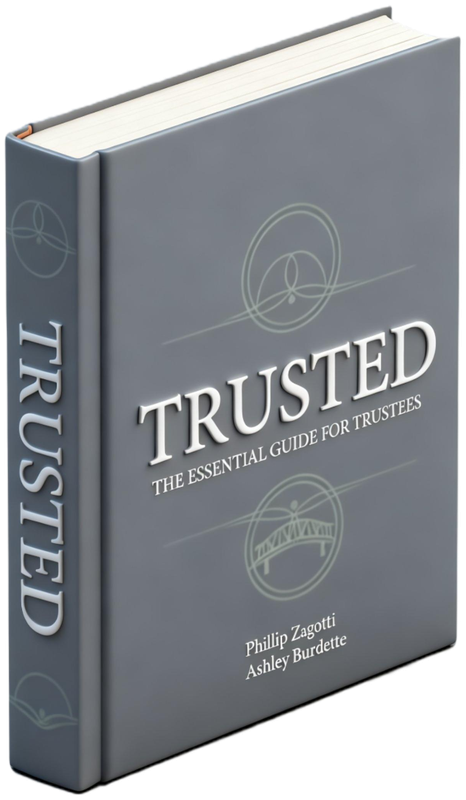
Proof, In Print
He wrote the book for trustees. And teaches it to other lawyers.
Phillip Zagotti co-authored Trusted: The Essential Guide for Trustees with Ashley Burdette, a plain-English manual on what a trustee actually has to do, from the day the trust is funded through the final accounting. The book is the basis for his eight-part continuing legal education series on trust law for LexVid, taught to attorneys nationwide, covering trust structure, fiduciary duties and risk management, and government benefits planning with special needs and Medi-Cal trusts. The same material is what goes into the trusts we draft and the administrations we handle.
Questions & Answers
Trust and estate tax questions trustees ask
The trust only earns a little interest. Does it still have to file?
Federally, a trust files Form 1041 once gross income reaches $600, or if any beneficiary is a nonresident alien. California’s Form 541 threshold is lower still. Most trusts holding any investments or a rental have to file every year until they distribute.
Is there a California estate tax?
No. California has no estate tax and no inheritance tax. The federal estate tax applies only above the federal exemption, which is $15 million per person for 2026 deaths. What California does tax is the trust’s income each year and the gain on assets the trust sells, which is why the basis step-up matters so much.
Should we file a Form 706 even if no tax is due?
If the decedent was married, usually yes, to elect portability of the unused exemption to the surviving spouse. It is inexpensive relative to what it can save if the survivor’s estate later grows, and the election is only available on a timely filed return.
The beneficiaries live in three states. Where is the trust taxed?
California taxes its share based on the trustee’s and each non-contingent beneficiary’s residence; each beneficiary reports the K-1 income in their own state. Getting the allocation right on Form 541 is what keeps the trust from paying California tax on income that belongs to an Oregon beneficiary.
The trustee signs the return. Make sure someone who understands it prepared it.
A free consultation for trustees and executors with an attorney-CPA, and a flat fee in writing for the returns.