
Bankruptcy ✦ California
A Fresh Start Is a Legal Right. Let’s Find Out What Yours Looks Like.
Chapter 7, Chapter 13, and Subchapter V bankruptcy for individuals and small businesses in the Central District of California, including the Riverside Division that serves the Inland Empire. Handled start to finish by an attorney-CPA who can tell you which debts, including tax debts, actually go away. Flat fees. Payment plans. Free consultation.
Overview
Bankruptcy is a toolbox. Pick the right tool.
The Bankruptcy Code offers different chapters for different problems, and the choice depends on your income, your assets, what you are trying to keep, and what you owe. We run the analysis before you decide anything: the means test, the exemption comparison, the tax discharge tests, and the Chapter 13 plan math. Then you get a written recommendation and a flat fee.
- Chapter 7: liquidation and discharge, usually in about four months
- Means test analysis and California exemption planning (CCP §§ 703.140 and 704)
- Chapter 13: a three-to-five-year plan that stops foreclosure and repossession
- Curing mortgage arrears, cramming down vehicle loans, and stripping junior liens
- Subchapter V: streamlined Chapter 11 reorganization for small businesses
- Business wind-downs and personal guaranties for owners of closing companies
- Discharging income tax debt: the four tests under §§ 507 and 523
- Paying priority tax through a plan instead of an IRS installment agreement
- SBA EIDL and 7(a) loans, Treasury offset, and personal guaranties
- Judgments, wage garnishments, and creditor lawsuits: the automatic stay
- Creditor side: defending preference and clawback demands from a customer’s bankruptcy trustee
Which Chapter
How do the chapters compare?
Every case is different, but this is the shape of the decision. The consultation is where we put your numbers into it.
| Chapter 7 | Chapter 13 | Subchapter V | |
|---|---|---|---|
| Who it fits | Individuals and businesses with limited income and little non-exempt property | Individuals with regular income who need to keep a house or car, or who fail the means test | Small businesses (and their owners) with under about $3 million in debt that need to keep operating |
| What happens to debt | Unsecured debt is discharged; non-exempt assets, if any, are sold by the trustee | Debt is paid in part through a plan; the balance is discharged at the end | Debt is restructured under a plan the owner proposes; equity stays with the owner |
| Timeline | About 4 months from filing to discharge | 36 to 60 months of plan payments | Plan filed within 90 days; confirmation typically within a few months |
| Keeps the house? | Yes if equity fits within the homestead exemption and payments are current | Yes; arrears are cured through the plan while the stay stops foreclosure | Yes for business real estate; personal residence handled with the owner’s own case if needed |
| Tax debt | Old income tax discharged if it passes the four tests; recent tax survives | Priority tax paid through the plan without further penalties; dischargeable tax treated as unsecured | Priority tax paid over the plan term; business payroll tax addressed with the IRS in the plan |
The Automatic Stay
When does collection actually stop?
The moment the petition is filed. Under 11 U.S.C. § 362, filing creates an automatic stay that stops foreclosure sales, repossessions, wage garnishments, bank levies, lawsuits, and collection calls, federal, state, and private, without a hearing and without asking anyone’s permission. A creditor who keeps going after the filing violates federal law.
For Inland Empire residents that filing goes to the Riverside Division of the U.S. Bankruptcy Court for the Central District of California, one of the busiest bankruptcy courts in the country. We know its judges, its trustees, and its local rules, and because the filing is electronic, the stay can be in place the same day you decide to proceed if a foreclosure sale or a garnishment is imminent.

About 100 days, start to finish, for a typical Chapter 7.
Is Chapter 7 right for me?
Chapter 7 is the fastest and cleanest fresh start: the trustee reviews your assets, sells anything that is not exempt (in most consumer cases, nothing), and the court discharges your unsecured debts in about four months. Eligibility turns on the means test under 11 U.S.C. § 707(b): if your household income is below the California median for your household size, you qualify; if it is above, a deduction-based calculation decides. As a CPA-led firm we run the means test precisely, including the deductions most filers miss.
California does not allow the federal exemptions, but it offers two exemption systems of its own, and you choose one. The § 704 system protects a homestead of between roughly $300,000 and $600,000 (indexed annually) and is built for homeowners. The § 703.140 system has a smaller homestead but a large wildcard that protects cash, vehicles, and other property, and is often better for renters. Choosing the wrong system can cost you a house or a bank account; we model both before filing. Read more →
How does Chapter 13 save a house or a car?
Chapter 13 is a court-supervised repayment plan, three to five years long, funded from your income. It is the chapter for people who are behind on a mortgage and want to keep the house: the automatic stay stops the foreclosure, and the plan cures the arrears over its term while you resume regular payments. It also lets you cram a vehicle loan down to the car’s value if the loan is old enough, strip a wholly unsecured junior lien from the house, and pay priority tax debt without further penalties or interest.
Plan payments are calculated from your budget under the means test, and unsecured creditors receive what is left, which is often a small percentage. At the end of the plan the remaining unsecured balance is discharged. Chapter 13 is also the answer when a debtor has too much non-exempt property for Chapter 7, or has income above the means test threshold. Read more →
What is Subchapter V, and is my business small enough?
Subchapter V of Chapter 11 is the small business reorganization chapter, created in 2020 to make Chapter 11 workable for companies that could never afford the traditional version. A business with total debts under the statutory cap (indexed, currently just under $3.4 million), at least half of it from business activity, can file, propose its own plan within 90 days, keep its equity, and confirm the plan over creditor objection if it commits its projected disposable income for three to five years. There is no creditors’ committee and no competing plans; a Subchapter V trustee facilitates rather than runs the case.
This is the chapter for the business that is viable but buried: an SBA loan it cannot service, a landlord or a lender that will not negotiate, a payroll tax arrearage, or a judgment that threatens the accounts. We prepare the projections, the plan, and the disclosure, and handle the owner’s personal guaranty exposure in the same engagement. The forensic accounting side of the practice is what makes the projections credible to the court and the trustee. Read more →
Can bankruptcy really wipe out tax debt?
Yes, income tax, if it passes four tests. The return was due, including extensions, more than three years before the bankruptcy filing (11 U.S.C. § 507(a)(8)(A)(i)). The return was actually filed more than two years before the filing (§ 523(a)(1)(B)). The tax was assessed more than 240 days before the filing (§ 507(a)(8)(A)(ii)). And there was no fraud or willful evasion (§ 523(a)(1)(C)). Tax that passes all four is a general unsecured claim, discharged in Chapter 7 and paid pennies in Chapter 13. Tax that fails any one is a priority claim: it survives Chapter 7, but can be paid through a Chapter 13 or Subchapter V plan without ongoing penalties.
The dates come from the IRS account transcripts, and events like an offer in compromise, a prior bankruptcy, or a collection due process request pause the clocks. Reading those transcripts correctly, and timing the filing to the day the tax becomes dischargeable, is the single highest-value thing an attorney-CPA does in a tax-driven bankruptcy. Payroll trust fund taxes and sales taxes collected from customers are never discharged; those get a different strategy. The FTB follows the same federal tests for California income tax. Read more →
What about SBA loans, judgments, and business debt?
COVID-era EIDL and PPP loans, SBA 7(a) loans, and the personal guaranties behind them have become one of the most common reasons California owners call us. An EIDL over $200,000 carries a personal guaranty; a defaulted loan goes to Treasury for offset of your tax refunds and federal payments with a 30 percent collection fee added; and the SBA can pursue the guarantor for years. Bankruptcy discharges the personal guaranty of an SBA loan the same as any other unsecured debt, and Subchapter V can restructure the business’s own obligation.
Judgments, wage garnishments, and creditor lawsuits stop with the automatic stay and are discharged with the underlying debt. Where bankruptcy is not the right answer, we also handle the alternatives: an SBA offer in compromise, a Treasury cross-servicing negotiation, or a workout with the lender. The analysis of which path costs less is a spreadsheet, and we build it before you choose. Read more →

The Attorney-CPA Difference
Bankruptcy is a legal proceeding built on a financial statement. We are fluent in both.
- Means test, exemptions, and plan payments computed by a CPA, not estimated
- Tax discharge dates read directly from IRS and FTB transcripts, with the filing timed to them
- Subchapter V projections and business schedules prepared by a forensic accountant
- Representation in the Riverside Division and throughout the Central District of California
- Flat fee quoted in writing, with payment plans before filing
Proof, In Print
He wrote the book on tax defense. Literally.
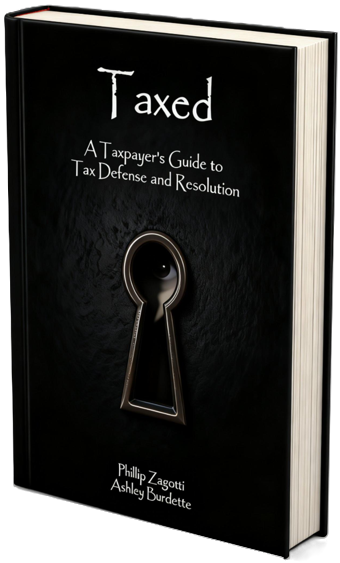
Phillip Zagotti co-authored Taxed: A Taxpayer’s Guide to Tax Defense and Resolution with Ashley Burdette, which includes a chapter on when bankruptcy is the right tool for tax debt and how the discharge rules on this page actually work. If tax debt is a large part of what you owe, it is worth reading before you decide between an IRS installment agreement and a bankruptcy filing.
Questions & Answers
Bankruptcy questions Californians ask us
Will I lose my house or my car in Chapter 7?
Usually not. California’s § 704 homestead exemption protects several hundred thousand dollars of home equity, and vehicles with modest equity are exempt under either system. If your equity exceeds the exemption, Chapter 13 lets you keep the property by paying the non-exempt value through the plan. We tell you which applies before you file.
How much does bankruptcy cost?
A flat attorney fee quoted in writing, plus the court filing fee. Chapter 7 fees are paid before filing; Chapter 13 fees are largely paid through the plan; Subchapter V is quoted on the complexity of the business. Payment plans are available, and the consultation is free.
Which court will my case be in?
Riverside and San Bernardino County residents file in the Riverside Division of the U.S. Bankruptcy Court for the Central District of California. Los Angeles, Orange, Ventura, Santa Barbara, and San Luis Obispo County residents file in the Los Angeles, Santa Ana, or Northern Divisions of the same court. Hearings are largely by video.
Can I file bankruptcy on tax debt and keep my business open?
Often, yes. Chapter 13 for an individual owner, or Subchapter V for the business, pays priority tax through a plan while the business keeps operating. We coordinate the bankruptcy plan with the IRS and FTB so the tax is resolved inside the case rather than outside it.
Find out what a fresh start looks like, for free.
A confidential case review with an attorney-CPA, a written recommendation on the right chapter, and a flat fee before you commit.