
Trusts & Estates ✦ Special Needs & Medi-Cal
Provide for Them Without Costing Them Their Benefits.
An inheritance left outright to a family member on SSI or Medi-Cal can end the benefits the day it arrives. A special needs trust holds the inheritance for their benefit without counting against them. North Star Law Firm drafts third-party and first-party special needs trusts, coordinates ABLE accounts, and plans for Medi-Cal long-term care under California’s post-2024 rules. From the LexVid faculty member who teaches this to other attorneys. Flat fee. Statewide.
The Short Answer
Yes, you can leave them money. Just not directly.
Supplemental Security Income and Medi-Cal are needs-based, and the resource limit for SSI is $2,000. An inheritance, a life insurance payout, or a personal injury settlement received outright puts the beneficiary over that limit and suspends benefits until the money is spent down, usually on things the benefits would have covered anyway. A special needs trust is a trust that holds those assets for the beneficiary’s supplemental needs, things public benefits do not pay for, under a trustee’s discretion, so that the assets are not counted as the beneficiary’s resource. Done correctly, the beneficiary keeps the benefits and gets the inheritance too. Done incorrectly, or not at all, a lifetime of savings disappears in months.
- Third-party special needs trusts funded by parents, grandparents, or a family trust at death
- First-party (d)(4)(A) trusts for a beneficiary’s own assets, settlements, or back benefits, with the Medi-Cal payback
- Pooled trusts through a nonprofit for smaller amounts
- CalABLE and other ABLE accounts under I.R.C. § 529A, coordinated with the trust
- Trustee guidance on distributions that do not reduce SSI (housing, food, and in-kind support rules)
- Medi-Cal long-term care planning and the estate recovery rules for trusts and probate estates
Two Kinds
Third-party or first-party trust: which one applies?
The source of the money decides the type of trust, and the type of trust decides what happens to what is left when the beneficiary dies.
| Third-party special needs trust | First-party special needs trust | |
|---|---|---|
| Funded with | Someone else’s assets: parents, grandparents, siblings, a family trust at death | The beneficiary’s own assets: an inheritance received outright, a settlement, back benefits |
| Authority | California trust law; the trustee’s discretion over supplemental needs | 42 U.S.C. § 1396p(d)(4)(A); Cal. Prob. Code § 3604 for court-established trusts; Welf. & Inst. Code § 14009.5 |
| Age limit | None | Beneficiary must be under 65 when funded |
| Who can create it | The donor, in a living trust or a standalone trust | The beneficiary, a parent, grandparent, guardian, or the court (since 2016 the beneficiary may create their own) |
| Payback at death | None; remaining assets pass to whoever the donor named | Medi-Cal must be repaid from remaining assets before anyone else receives them |
| Typical use | Estate planning for a family with a disabled child or grandchild | Protecting a settlement or an inheritance that was left outright by mistake |
What the trustee of a special needs trust can and cannot pay for
The rules that keep the trust from counting against the beneficiary also govern how it is spent. Distributions for medical and dental care not covered by Medi-Cal, education, transportation, a vehicle, travel, electronics, recreation, and personal services are supplemental and do not affect SSI. Distributions for food or shelter are in-kind support and maintenance and reduce the SSI payment, sometimes by a third, though they may still be worth making. Cash paid directly to the beneficiary is income and reduces SSI dollar for dollar. Paying a vendor directly, rather than reimbursing the beneficiary, is the habit that keeps the trustee out of trouble. We give trustees a written distribution guide and are available when a question comes up.
ABLE accounts, and how they fit with the trust
A CalABLE account lets a person whose disability began before age 46 hold up to $100,000 without affecting SSI and any amount without affecting Medi-Cal, with tax-free growth for qualified disability expenses, including housing, which a special needs trust cannot pay for without an SSI reduction. Annual contributions are capped at the gift tax exclusion amount. The account is owned by the beneficiary, so it carries a Medi-Cal payback at death in most states, though California has limited its recovery from ABLE accounts. The common structure is a third-party special needs trust as the long-term vehicle and an ABLE account funded from it for housing and day-to-day expenses, drafted so the trust can make those transfers.
Medi-Cal long-term care planning after the 2024 asset limit change
California eliminated the Medi-Cal asset limit effective January 1, 2024, so an applicant’s savings no longer disqualify them, and only income is tested. That removed most of the spend-down planning that older Medi-Cal strategies were built around. What remains is estate recovery: since 2017 the state can recover Medi-Cal costs only from a probate estate (Welf. & Inst. Code § 14009.5), which means assets held in a living trust or passing by beneficiary designation are not subject to recovery, and a funded living trust is itself the primary Medi-Cal planning tool for most families. For families with a disabled adult child, transfers to a trust for that child’s sole benefit remain exempt from the federal transfer rules, and the special needs trust and the living trust are drafted together.
The Attorney-CPA Difference
Public benefits rules are federal, state, and unforgiving. We draft to all of them.
- Third-party and first-party trusts drafted to the Social Security POMS and Medi-Cal rules
- Distribution guidance for trustees, so the trust does not undo what it was built to protect
- ABLE accounts and the living trust coordinated with the special needs trust
- Medi-Cal recovery planning under California’s post-2017 and post-2024 rules
- Taught by the co-author of Trusted in his LexVid CLE course on government benefits planning
Proof, In Print
He wrote the book for trustees. And teaches it to other lawyers.
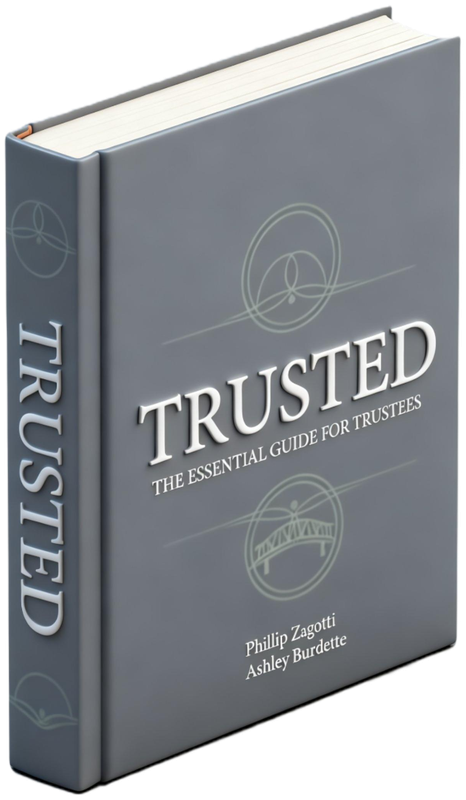
Phillip Zagotti co-authored Trusted: The Essential Guide for Trustees with Ashley Burdette, a plain-English manual on what a trustee actually has to do, from the day the trust is funded through the final accounting. The book is the basis for his eight-part continuing legal education series on trust law for LexVid, taught to attorneys nationwide, covering trust structure, fiduciary duties and risk management, and government benefits planning with special needs and Medi-Cal trusts. The same material is what goes into the trusts we draft and the administrations we handle.
Questions & Answers
Special needs planning questions California families ask
My son receives SSI. Can I just leave his share to his sister to hold for him?
Please do not. The sister’s creditors, divorce, or death can take the money; she has no legal duty to use it for him; and the arrangement can itself be treated as his resource. A third-party special needs trust with the sister as trustee accomplishes what you intend, safely.
My daughter already inherited money outright and lost her benefits. Is it too late?
No. A first-party special needs trust can be established with her own assets if she is under 65, and benefits can be restored once the assets are in the trust. It carries a Medi-Cal payback at death, which the third-party trust would have avoided, but it fixes the problem.
Who should be the trustee?
Someone organized, willing to learn the rules, and likely to outlive the beneficiary or be replaced in an orderly way. A sibling with a professional co-trustee or a pooled trust is a common answer. The trust should name successors and allow for a professional to step in.
Does the trust have to file tax returns?
A third-party trust files Form 1041 and California Form 541 annually and is usually taxed as a complex trust; a first-party trust is typically a grantor trust reported on the beneficiary’s return. We prepare either as part of the plan.
The inheritance should help them, not disqualify them.
A free consultation with an attorney-CPA who teaches special needs and Medi-Cal planning to other attorneys, and a flat fee in writing.