
Tax Law ✦ Tax Court & OTA
When the Agency Is Wrong, There Is a Judge for That.
The U.S. Tax Court hears federal cases before you pay. California’s Office of Tax Appeals hears Franchise Tax Board and CDTFA cases before an independent panel. Both are forums where prepared taxpayers win, and both have deadlines that cannot be extended. Phillip Zagotti is admitted to the U.S. Tax Court and handles OTA appeals from the protest stage forward. Flat fees. Statewide.
The Short Answer
You do not have to pay first, and you do not have to accept the agency’s answer.
A Notice of Deficiency gives you 90 days to petition the U.S. Tax Court, where the tax is contested before it is paid. A Franchise Tax Board Notice of Action gives you 30 days to appeal to the Office of Tax Appeals, where a three-judge panel that does not work for the FTB decides the case. Most cases in both forums settle before trial, on terms that reflect the agency’s risk of losing, and that is the point: filing the petition or the appeal is what creates the risk. Miss the deadline and the assessment is final, and the only path left is paying and suing for a refund.
- U.S. Tax Court deficiency cases, including the small tax case procedure for disputes under $50,000
- Collection due process appeals to the Tax Court after an IRS Appeals determination
- Office of Tax Appeals cases against the FTB (income and franchise tax) and the CDTFA (sales and use tax)
- Residency, sourcing, and business-income cases, the OTA’s most common individual disputes
- Innocent spouse and penalty cases in both forums
- Refund suits in superior court after an OTA loss, and coordination with IRS Appeals settlements
Two Forums
How do the Tax Court and the OTA compare?
A California taxpayer with a federal adjustment usually has a parallel state case, and the two forums operate differently.
| U.S. Tax Court | Office of Tax Appeals | |
|---|---|---|
| What it hears | IRS deficiencies, CDP determinations, innocent spouse, certain penalty and interest cases | Appeals from FTB Notices of Action and claim denials; CDTFA decisions on petitions and refund claims |
| Deadline | 90 days from the Notice of Deficiency (150 if addressed outside the U.S.); 30 days from a CDP determination | 30 days from an FTB Notice of Action (R&TC § 19045); 90 days from denial of a refund claim (§ 19324); 30 days from a CDTFA decision |
| Pay first? | No; the tax is not assessed while the case is pending | No for FTB deficiency appeals; refund cases require payment first |
| Who decides | A Tax Court judge, sitting in Los Angeles or San Diego for California cases; small cases are informal and not appealable | A panel of three administrative law judges; hearings in Sacramento, Los Angeles, or by video; written opinions, some designated precedential |
| Settlement | Most cases are referred to IRS Appeals and settle there | Most cases settle with the FTB’s or CDTFA’s settlement bureau during the appeal |
| After a loss | Appeal to the Ninth Circuit (except small cases) | The taxpayer may pay and sue for refund in superior court (R&TC § 19382); the FTB cannot appeal an OTA decision |
What makes a case winnable?
The record. Tax cases are decided on documents and on the credibility of the taxpayer’s reconstruction of events, and the record is built long before the hearing: in the audit response, the protest, and the Appeals conference. A residency case at the OTA turns on where the taxpayer actually lived, worked, banked, voted, and kept the things that mattered, documented month by month. A substantiation case in Tax Court turns on whether the expense records are reconstructed to the standard the court applies. A collection due process case turns on whether the IRS Appeals officer considered the collection alternative you proposed. We build the record from the first response with the hearing in mind, and most cases never need the hearing.
How does an OTA appeal actually proceed?
After a timely appeal, the OTA sets a briefing schedule: your opening brief, the agency’s brief, and your reply, with exhibits. The taxpayer may request an oral hearing before the panel or submit on the briefs. The FTB’s settlement bureau evaluates the case for settlement during that period, and the OTA can refer cases to mediation. Decisions are written, and the OTA’s precedential opinions on residency, sourcing, penalties, and the statute of limitations bind the FTB in later cases. A taxpayer who loses may petition for rehearing and, ultimately, pay and file a refund action in superior court; the FTB, by statute, gets no appeal. That asymmetry is one reason the FTB settles cases it thinks it might lose.
Why an attorney-CPA in a tax trial?
Because the case is a financial reconstruction presented under rules of evidence. The Tax Court will not accept an accountant’s summary without the underlying records; the OTA will not accept a residency narrative without the documents that support it. A representative who can build the reconstruction, testify to its methodology as an expert if needed, and argue the law is one professional doing what usually takes two. Enrolled agents and CPAs cannot appear in the Tax Court without passing its examination; attorneys can, and Phillip Zagotti is admitted.
The Attorney-CPA Difference
The petition is what creates leverage. The record is what wins.
- Every deadline calendared from the first notice: 90 days, 30 days, and the ones in between
- Records reconstructed to evidentiary standards from the protest stage forward
- IRS Appeals and FTB settlement bureau negotiations conducted with the trial risk quantified
- Admitted to the U.S. Tax Court; OTA appeals handled statewide by video
Proof, In Print
He wrote the book on tax defense. Literally.
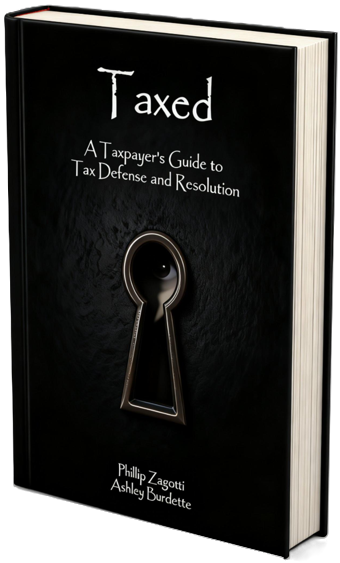
Phillip Zagotti co-authored Taxed: A Taxpayer’s Guide to Tax Defense and Resolution with Ashley Burdette. Its chapters on the 90-day letter and on appeals explain what the forums are, what the deadlines mean, and what a taxpayer can do alone. When the case needs counsel, the consultation is free.
Questions & Answers
Tax Court and Office of Tax Appeals questions we hear most
Is it worth petitioning the Tax Court for a small amount?
Often, yes. The small tax case procedure for disputes of $50,000 or less per year is informal, inexpensive, and most cases settle at IRS Appeals after the petition is filed. Filing preserves your rights; not filing makes the deficiency final.
I missed the 90-day deadline. Is it over?
The Tax Court door is closed, but not every door. You can pay the tax, file a claim for refund, and sue in district court; you may have an audit reconsideration request; and collection due process rights arise when the IRS moves to levy. Call anyway.
Can the FTB appeal if I win at the OTA?
No. Under California law only the taxpayer can seek further review, by paying the tax and filing a refund action in superior court. An OTA win against the FTB is final for the FTB.
Do I have to travel to a hearing?
Rarely. The Tax Court sits in Los Angeles and San Diego for California cases and increasingly holds proceedings remotely; the OTA conducts hearings by video from anywhere in the state. Most cases settle without a hearing at all.
The 90 days are running. So are the 30.
A free case evaluation with an attorney-CPA admitted to the U.S. Tax Court, and a flat fee in writing before you commit.