
Tax Law ✦ Offer in Compromise
Settle for Less Than You Owe. If the Formula Says You Can.
The IRS, the Franchise Tax Board, the CDTFA, and the EDD each accept offers in compromise, and each decides them by formula, not by sympathy. North Star Law Firm runs the formula first, tells you whether an offer is realistic before you pay a dime, and then prepares the offer to the standard the agencies actually apply. Attorney-CPA. Flat fees. Statewide.
The Short Answer
You qualify when what they could collect is less than what you owe.
An offer in compromise is accepted when the agency concludes it cannot collect more than the offer. That is a math problem: your net equity in assets, plus a multiple of what you could pay monthly after allowable living expenses, is your reasonable collection potential. If it is less than your balance, an offer is realistic. If it is more, the agency will reject the offer no matter how it is written, and you will have paid a fee and lost months while penalties and interest ran. That is why the analysis comes first here, and it is free.
- IRS offers under I.R.C. § 7122: doubt as to collectibility, doubt as to liability, effective tax administration
- FTB offers under R&TC § 19443 for individuals and businesses
- CDTFA offers under R&TC § 7093.5 and EDD offers under Unemp. Ins. Code § 1177
- Reasonable collection potential computed under the IRS national and Southern California local standards
- Sequencing federal and state offers so each agency’s financial statement matches the other’s
- Alternatives when the formula says no: partial-pay installment agreements, hardship status, bankruptcy analysis
Four Programs
How do the agencies’ offer programs compare?
A California taxpayer with balances at more than one agency has to work more than one program, and they do not talk to each other.
| IRS | FTB | CDTFA / EDD | |
|---|---|---|---|
| Authority | I.R.C. § 7122 | R&TC § 19443 | R&TC § 7093.5; Unemp. Ins. Code § 1177 |
| Who qualifies | Individuals and businesses; all returns filed; current on estimated payments | Individuals and businesses that cannot pay in full within a reasonable time; all returns filed | Generally taxpayers whose business has closed or who are no longer the operator; limited active-business offers |
| How it is measured | Reasonable collection potential: equity plus 12 or 24 months of disposable income | Ability to pay over the collection period, using the FTB’s own financial statement | Ability to pay; the agency looks at the closed business’s liquidation and the owner’s finances |
| Forms | Form 656 with Form 433-A (OIC) or 433-B (OIC); application fee and 20% down for lump-sum offers (waived for low income) | Form 4905 PIT (individuals) or 4905 BE (businesses); no application fee | CDTFA-490 / CDTFA-490-C; EDD DE 999A |
| While pending | Collection generally suspended; the collection statute is tolled | FTB may continue collection; no statutory suspension | Collection may continue |
| After acceptance | Five years of filing and payment compliance required or the offer defaults | Compliance conditions in the acceptance letter | Compliance conditions in the acceptance letter |
How is reasonable collection potential computed?
The IRS adds the quick-sale value of your assets (generally 80 percent of fair market value, less loans and exemptions) to your future income, which is your monthly income less the IRS’s allowable living expense standards, multiplied by 12 for a lump-sum offer or 24 for a periodic-payment offer. The standards are national for food and clothing, and local for housing and transportation, so a Riverside County renter and a San Bernardino County homeowner get different allowances. Equity in a retirement account counts. Equity in a home counts. A vehicle worth more than the allowance counts. Most rejected offers are rejected because the taxpayer, or a national tax-relief company, ignored one of those.
The FTB uses a similar approach but its own financial statement, and it weighs the twenty-year collection statute: an FTB collector who believes you can pay over a long horizon will say so. Where the IRS offer is realistic and the FTB offer is not, the sequence is to close the federal offer first and then present the FTB with the accepted federal terms.
Why do so many offers fail?
Because they were never realistic, or because they were prepared badly. National advertisers accept fees from anyone with a balance, file offers that the formula could never support, and let the taxpayer discover the rejection a year later with penalties and interest added. Even sound offers fail on execution: an unreported bank account, a vehicle valued at trade-in when the IRS uses private-party value, a missed estimated tax payment during the review, or a return that was not filed. The offer examiner is checking your financial statement against your transcripts, your credit report, and public records. We prepare it as if we were the examiner.
When the formula says no, the honest answer is a different tool. A partial-pay installment agreement often achieves the same economic result as an offer without the acceptance risk. Currently-not-collectible status lets the IRS ten-year statute run. And if the balance is old enough, a bankruptcy discharge may eliminate it entirely. Because this firm does all of those, the recommendation follows the numbers.
The Attorney-CPA Difference
Offer work is math first, advocacy second. We do both.
- Reasonable collection potential computed before you commit to anything
- Financial statements prepared to the standard the offer examiner applies
- IRS, FTB, CDTFA, and EDD offers sequenced so the statements are consistent
- Rejections appealed, and alternatives ready when an offer is the wrong tool
Proof, In Print
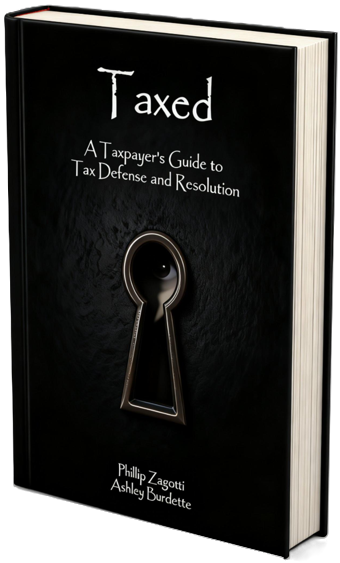
He wrote the book on tax defense. Literally.
Phillip Zagotti co-authored Taxed: A Taxpayer’s Guide to Tax Defense and Resolution with Ashley Burdette. Its offer in compromise chapter walks through the collection potential formula with examples, so you can see whether you are in the ballpark before anyone charges you. When you want it done professionally, the consultation is free.
Questions & Answers
Offer in compromise questions we hear most
Can I really settle for pennies on the dollar?
Some taxpayers can, when their assets and income are low relative to the balance. Most cannot, and the advertisers who promise it to everyone are the reason the IRS publishes warnings about them. The formula decides, and we will tell you what it says before you spend anything.
How long does an IRS offer take?
Six to twelve months is typical, longer for complex financials. Collection is generally suspended while the offer is pending, but interest continues and the collection statute is tolled for the pendency plus one year. Missing a filing or estimated payment during that time defaults the offer.
Does the FTB accept offers as readily as the IRS?
Less readily. The FTB has a twenty-year collection horizon and weighs it, and it does not suspend collection while an offer is pending. FTB offers succeed most often for taxpayers with permanent hardship, older taxpayers with fixed incomes, and closed businesses.
What if I owe both the IRS and the FTB?
Each agency will see the financial statement you gave the other, so the numbers must match. We generally close the IRS offer first and present the FTB with the federal outcome, and we address CDTFA or EDD balances with those agencies’ own programs.
Find out what the formula says, free.
A free offer analysis with an attorney-CPA, and a flat fee in writing before you commit.