
Trusts & Estates ✦ Trust Administration
You Were Named Trustee. Here Is What That Actually Means.
A parent or spouse has died, the trust names you as successor trustee, and the beneficiaries, the bank, the county, and two tax agencies are all waiting on you. Trust administration is a defined process with statutory deadlines and personal liability for getting it wrong. North Star Law Firm guides family trustees through it, or handles it for them, including every tax return along the way. From the co-author of Trusted. Flat fee. Statewide.
The Short Answer
It is a job with a checklist, a calendar, and a duty of care. It is manageable with help.
A trustee’s duties come from the trust document and from the California Probate Code, and they are fiduciary duties: loyalty, impartiality, prudence, and full disclosure. In practice that means giving statutory notice to every beneficiary and heir within 60 days of the death, gathering and valuing the assets as of the date of death, obtaining a tax identification number for the now-irrevocable trust, filing the decedent’s final returns and the trust’s fiduciary returns, paying debts, handling the real estate and its property tax filings, keeping records sufficient to account to the beneficiaries, and distributing according to the trust terms. A trustee who does these things carefully and on time is protected. A trustee who guesses is personally liable to the beneficiaries for the difference.
- Statutory notice under Prob. Code § 16061.7 within 60 days, starting the 120-day contest period
- Date-of-death valuations, EIN, and retitling of trust assets
- Decedent’s final Forms 1040 and 540; the trust’s Forms 1041 and 541; Form 706 if required
- Real property transfers, Proposition 19 filings with the assessor, and sale or distribution of the home
- Trust accountings under Prob. Code § 16062 and beneficiary communications
- Distribution planning: timing, the 65-day election, sub-trust funding, and final release
The Timeline
What happens when, after a death
Most administrations run six to eighteen months depending on the assets and whether real estate is sold. These are the checkpoints that carry deadlines.
| When | What the trustee does | Authority |
|---|---|---|
| Immediately | Locate the trust and will; secure the home and property; obtain death certificates; do not distribute anything | Prob. Code § 16000 (duty to administer per the trust) |
| Within 60 days | Serve the § 16061.7 notice on all beneficiaries and heirs, with a copy of the trust on request; this starts the 120-day period to contest | Prob. Code §§ 16061.7, 16061.8 |
| Within 150 days | File the Change in Ownership Statement, Death of Real Property Owner, with the assessor for each parcel; claim any Prop. 19 exclusion | Rev. & Tax. Code § 480; Prop. 19 |
| First 3 to 4 months | Obtain EIN; retitle accounts; obtain date-of-death appraisals (real estate, business interests); lodge the original will with the superior court within 30 days | Prob. Code § 8200 (will lodging) |
| By April 15 following | Decedent’s final income tax returns; first fiduciary returns (Form 1041 and Form 541) if the trust had income | I.R.C. §§ 6012, 6072; R&TC § 18505 |
| Within 9 months | Federal estate tax return (Form 706) if the gross estate exceeds the exemption, or to elect portability for a surviving spouse | I.R.C. § 6075 |
| Before distribution | Pay or reserve for debts and taxes; prepare the accounting; obtain receipts and releases from beneficiaries | Prob. Code §§ 16062, 16064 |
| After distribution | Final fiduciary returns; close the EIN; retain records | I.R.C. § 6012 |
The duties that get trustees sued
Most trustee liability comes from a handful of avoidable errors. Distributing to some beneficiaries before others, or before debts and taxes are paid, breaches the duty of impartiality and leaves the trustee personally responsible if the money runs short. Failing to give the § 16061.7 notice leaves the contest period open indefinitely. Commingling trust funds with personal funds, or borrowing from the trust, is self-dealing under Prob. Code § 16004 however innocent the intent. Letting the family home sit vacant and uninsured, or selling it to a relative below market, breaches the duty of prudence. And refusing to provide information or an accounting when a beneficiary asks invites a petition under § 17200 to compel it, at the trustee’s expense. Every one of these is prevented by doing the administration in order, in writing, with advice.
The tax work inside every administration
A death creates at least three taxpayers: the decedent through the date of death, the trust from the date of death forward, and, where a probate estate exists alongside the trust, the estate. Each has returns, and the trust’s returns carry decisions that change what the beneficiaries pay: whether to elect under I.R.C. § 645 to treat the trust as part of the estate for a fiscal year, whether to distribute income to the beneficiaries or retain it at the trust’s compressed brackets, whether to use the 65-day election to treat a January distribution as made in the prior year, and how to document the stepped-up basis on every asset before anything is sold. California adds Form 541 and its own resident-trust rules. This is the part of administration most trustees hand to a preparer who has never seen a fiduciary return; here it stays in the same office, prepared by a CPA, alongside the legal work.
Trustee compensation, and when to hire a professional trustee
A family trustee is entitled to reasonable compensation under Prob. Code § 15681 unless the trust says otherwise, and taking it is neither greedy nor required. Some trustees waive it to keep peace; others are managing a rental property and a business and should be paid. Where the family dynamics are difficult, the assets are complex, or the trust continues for years for a young or disabled beneficiary, a licensed professional fiduciary or a corporate trustee may be the better choice, and a family trustee can resign in favor of one under the trust’s terms or § 15640. We advise on both, and we serve as counsel to whichever trustee is in place.
The Attorney-CPA Difference
The trustee’s manual, written by the people who wrote the trustee’s manual.
- Step-by-step guidance for family trustees, or full administration handled by the firm
- Every statutory notice and deadline calendared from the date of death
- Fiduciary income tax returns, the final returns, and Form 706 prepared in-house
- Real property, Proposition 19, and sale or distribution of the home handled with the assessor’s rules in view
- Accountings and releases that end the administration and the trustee’s exposure
Proof, In Print
He wrote the book for trustees. And teaches it to other lawyers.
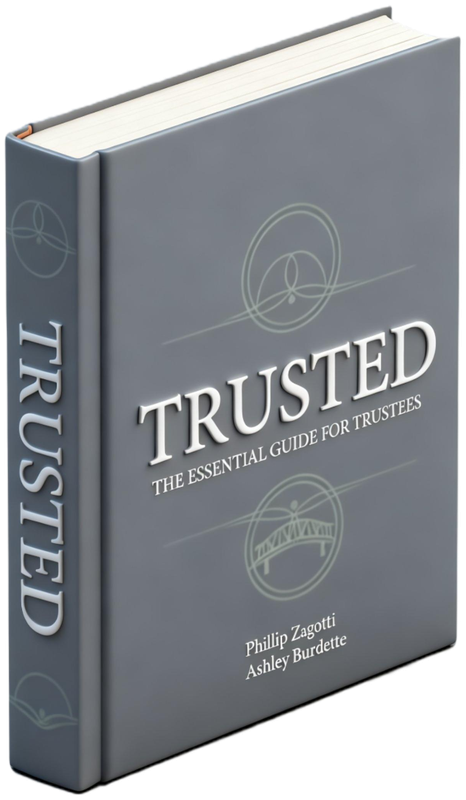
Phillip Zagotti co-authored Trusted: The Essential Guide for Trustees with Ashley Burdette, a plain-English manual on what a trustee actually has to do, from the day the trust is funded through the final accounting. The book is the basis for his eight-part continuing legal education series on trust law for LexVid, taught to attorneys nationwide, covering trust structure, fiduciary duties and risk management, and government benefits planning with special needs and Medi-Cal trusts. The same material is what goes into the trusts we draft and the administrations we handle.
Questions & Answers
Trustee questions we hear most
Do I have to hire the lawyer who drafted the trust?
No. The successor trustee chooses counsel, and many family trustees come to us precisely because they want the administration and the tax returns handled by one attorney-CPA office.
How long do I have to distribute the trust?
California has no fixed deadline, but the duty is to administer within a reasonable time, and a trustee who delays without reason invites a petition. Most straightforward administrations finish within a year; those with real estate sales, business interests, or a Form 706 take longer.
A beneficiary is demanding money now. Can I make a partial distribution?
Often, once the notice period has run and debts and taxes are estimated, and only in a way that treats all beneficiaries impartially. A written partial distribution with a reserve for expenses and taxes is common; an early distribution to one beneficiary that leaves the others short is a breach.
The trust owns the family home and one child lives in it. What now?
That is one of the most common and most contentious situations in trust administration. The trust terms control; if they are silent, the trustee must treat all beneficiaries fairly, which usually means a sale, a buyout at appraised value, or a documented rental arrangement, and Proposition 19 affects the property tax result of each. Get advice before doing anything.
You did not ask to be trustee. You can still do it right.
A free consultation for successor trustees with the co-author of Trusted, and a flat fee in writing for the administration.