
Trusts & Estates ✦ Wills & Powers of Attorney
The Documents Everyone Needs, Trust or No Trust.
A will names who inherits and who raises your children. A durable power of attorney and an advance health care directive name who acts for you if you cannot act for yourself. Every adult in California should have all three, and every trust plan includes them. North Star Law Firm drafts them to California’s formalities, with the tax and family issues thought through. Flat fee. Free consultation. Statewide.
The Short Answer
A will alone does not avoid probate. A will is still essential.
A will controls property in your own name at death and is administered through probate, the court process a living trust is designed to avoid. So for most California homeowners a will is the backup document, the pour-over will that catches anything left outside the trust. But the will is also the only document in which you can nominate a guardian for minor children, and it is the right primary plan for renters and others whose assets fit within California’s small estate procedures. The powers of attorney and the health care directive are different animals: they operate while you are alive and incapacitated, and without them your family’s only option is a court conservatorship, which is probate’s expensive cousin.
- Wills that meet California’s formalities (Prob. Code § 6110) and pour-over wills coordinated with a trust
- Guardianship nominations for minor children, and trusts for their inheritance
- Durable powers of attorney for finances, including authority over tax matters and real property
- Advance health care directives and HIPAA authorizations
- Small estate planning under Prob. Code § 13100 and the § 13150 primary residence petition
- Review of old wills, holographic wills, and out-of-state documents after a move to California
Which Plan
When is a will enough, and when is a trust needed?
California’s probate thresholds decide the question more than anything else. The figures adjust every three years; these are the amounts for deaths on or after April 1, 2025.
| Your situation | What passes without full probate | What you need |
|---|---|---|
| Renter, accounts under the small estate threshold | Personal property totaling $208,850 or less passes by affidavit under Prob. Code § 13100 forty days after death | A will, powers of attorney, and a directive; beneficiary designations on accounts |
| Homeowner, primary residence worth $750,000 or less, few other assets | Since April 1, 2025, a primary residence up to $750,000 can pass by a simplified petition under Prob. Code § 13150 (AB 2016), plus the personal property affidavit | Often still a trust, because the petition is a court proceeding with a hearing and requires the decedent to have lived in the home; a trust avoids it entirely |
| Homeowner above those limits, or with rental property | Nothing; full probate with statutory fees under §§ 10800 and 10810 | A revocable living trust with a pour-over will |
| Married couple, all community property to the survivor | A spousal property petition under § 13650 confirms property to the surviving spouse without full probate | A trust remains the better plan for the second death and for incapacity |
| Parents of minor children, any assets | Depends on the assets | A will with guardianship nominations and a trust for the children’s inheritance, so they do not receive it outright at 18 |
What makes a California will valid, and what makes it fail
A will must be in writing, signed by the testator, and witnessed by two people who sign during the testator’s lifetime and understand they are witnessing a will (Prob. Code § 6110). California also honors a holographic will, handwritten and signed by the testator with no witnesses, if the material provisions are in the testator’s handwriting (§ 6111), and it offers a statutory fill-in-the-blanks will (§ 6240). Wills fail on the details: a witness who is also a beneficiary creates a presumption of undue influence (§ 6112); a will that is not self-proving requires tracking down witnesses years later; an out-of-state will is valid here but may not address California community property or Proposition 19. We draft a self-proving will with disinterested witnesses, and we review any existing document before assuming it works.
What a durable power of attorney should actually say
California’s statutory form power of attorney (Prob. Code § 4401) is a checklist of powers, and most people check every box without reading them. A tailored durable power of attorney addresses the decisions an agent really faces: whether to sell the house to fund care, whether to make gifts or fund a trust for tax or Medi-Cal planning, whether to deal with the IRS and the FTB (which require their own forms, but honor a power that authorizes them), and whether the power is effective immediately or springs into effect on incapacity, and if so who decides that incapacity has occurred. It also names successor agents, because the first choice is often the spouse who is incapacitated at the same time.
The advance health care directive (§ 4700 et seq.) does the same for medical decisions: who decides, what your wishes are about life support, feeding, and pain management, and what happens to your remains. Both documents end at death, which is why the will and the trust take over from there.
The Attorney-CPA Difference
Every plan has these four documents. Ours are drafted to be used, not filed.
- Wills self-proving and coordinated with the trust, with guardianship nominations for minor children
- Powers of attorney tailored to the decisions your agent will actually make, including tax authority
- Health care directives that reflect your wishes rather than a form’s defaults
- Small estate planning for clients who do not need a trust, told honestly
Proof, In Print
He wrote the book for trustees. And teaches it to other lawyers.
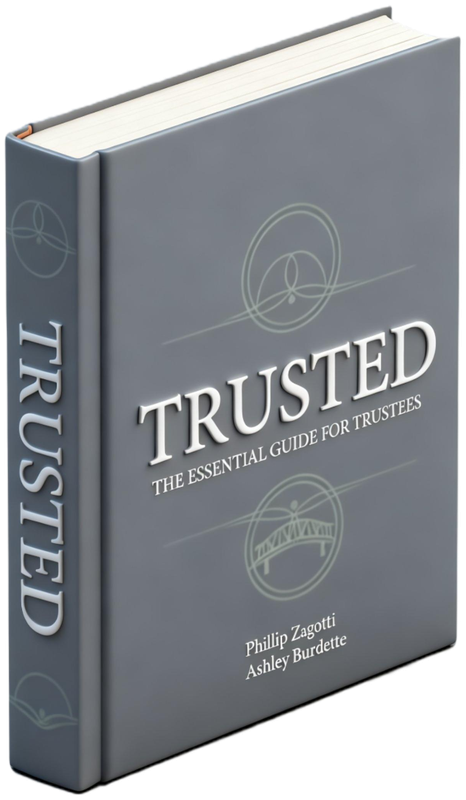
Phillip Zagotti co-authored Trusted: The Essential Guide for Trustees with Ashley Burdette, a plain-English manual on what a trustee actually has to do, from the day the trust is funded through the final accounting. The book is the basis for his eight-part continuing legal education series on trust law for LexVid, taught to attorneys nationwide, covering trust structure, fiduciary duties and risk management, and government benefits planning with special needs and Medi-Cal trusts. The same material is what goes into the trusts we draft and the administrations we handle.
Questions & Answers
Will and power of attorney questions California families ask
Can I just write my will by hand?
California recognizes a holographic will if the signature and material provisions are in your handwriting. It is better than nothing and worse than almost anything else: it invites disputes, it is not self-proving, and it cannot create a trust for children or address tax issues. Use it only as a stopgap.
If I have a trust, why do I need a will at all?
For the assets you never moved into the trust and for the guardianship nomination. The pour-over will sends everything outside the trust into it, and it is the only document in which California lets you name a guardian for minor children.
My spouse is my agent under the power of attorney. Is that enough?
Name at least one successor. Spouses are commonly incapacitated together, in an accident or by age, and a power of attorney with no available agent leaves the family in conservatorship court.
I moved to California with a will from another state. Is it valid here?
A will validly executed where you lived is valid in California. It probably does not address California community property, Proposition 19, or the probate thresholds above, and a California trust may now be the better plan. We review it as part of the consultation.
Four documents. One afternoon. A decade of peace of mind.
A free consultation with an attorney-CPA, and a flat fee in writing before you commit.