
Trusts & Estates ✦ Living Trusts
The Document That Keeps Your Family Out of a California Courtroom.
A revocable living trust is the standard estate plan for California homeowners because California probate is slow, public, and priced by statute as a percentage of everything you own. North Star Law Firm drafts the trust, the pour-over will, and the powers of attorney together, records the deed that funds it, and builds the tax planning in from the start. Flat fee. Free consultation. Statewide.
The Short Answer
If you own a home in California, you almost certainly want one.
A living trust is a legal container you create while you are alive, put your house and accounts into, and control completely as trustee. Nothing changes day to day: you buy, sell, refinance, and spend as before, and you can amend or revoke the trust at any time. What changes is what happens when you die or become incapacitated. Instead of a court-supervised probate that takes a year or more and pays the attorney and executor statutory fees off the top, your successor trustee steps in privately, pays the bills, and distributes what is left to the people you named, usually within a few months. For a married couple with a house in Riverside County, the probate the trust avoids would cost tens of thousands of dollars and most of a year.
- Revocable living trust drafted for your family, not from a form
- Pour-over will, durable power of attorney, and advance health care directive in the same package
- Deed transferring the home into the trust, recorded with the assessor’s reassessment exclusion claimed
- Written funding instructions for accounts, and beneficiary designation review for retirement plans and life insurance
- Community property treatment for married couples, with the full basis step-up preserved
- Amendments and restatements when the law or your life changes
The Package
What is in a complete California trust plan?
The trust is the centerpiece, but it does not work alone. Each document below covers a situation the others do not.
| Document | What it does | Why it matters in California |
|---|---|---|
| Revocable living trust | Holds title to your assets; names a successor trustee and beneficiaries; can include sub-trusts for children, a spouse, or a beneficiary with special needs | Avoids probate under Prob. Code §§ 10800 and 10810 statutory fees; keeps the plan private; provides for incapacity without a conservatorship |
| Pour-over will | Sends anything left outside the trust into it at death; nominates guardians for minor children | The safety net for assets acquired later or never retitled; without it, those pass by intestacy (Prob. Code § 6400 et seq.) |
| Durable power of attorney | Names an agent to handle finances if you cannot (Prob. Code § 4000 et seq.) | Covers assets outside the trust and dealings with the IRS, the FTB, and Social Security; avoids a court conservatorship |
| Advance health care directive | Names a health care agent and states your treatment wishes (Prob. Code § 4700 et seq.) | California’s statutory form is a starting point; a tailored directive addresses the decisions families actually face |
| HIPAA authorization | Lets your agents obtain medical information | Without it, providers may refuse to talk to the people you named |
| Trust transfer deed | Moves the house into the trust; recorded with the county | Filed with a Preliminary Change of Ownership Report claiming the exclusion so the transfer does not trigger reassessment |
| Certification of trust | A short summary banks and title companies accept instead of the full trust (Prob. Code § 18100.5) | Keeps the trust terms private while proving the trustee’s authority |
Why funding is the step that decides whether the plan works
A trust controls only what it owns. A beautifully drafted trust sitting in a binder while the house is still titled in your individual name accomplishes nothing; at death the house goes through probate anyway, and the family learns the hard way that the plan was never finished. Document services and do-it-yourself kits stop at the signing. We do not. We prepare and record the deed, file the assessor’s change-in-ownership report with the reassessment exclusion, give you written instructions for retitling accounts, and review beneficiary designations on retirement accounts and life insurance, which pass outside the trust and have to be coordinated with it.
When a trust is found unfunded after death, California offers a partial remedy: a petition under Estate of Heggstad asking the court to confirm that an asset the settlor intended to hold in trust is a trust asset. It works often, but it is a court proceeding with a hearing and a fee, and it is exactly what the trust was supposed to avoid. Funding at signing is cheaper.
What a married couple’s trust has to get right
Most married Californians hold their assets as community property, and that carries a tax gift: at the first spouse’s death, both halves of community property receive a new basis equal to fair market value under I.R.C. § 1014(b)(6), not just the decedent’s half. A trust that inadvertently converts community property to separate property, or that fails to document the community character of assets, forfeits half of that step-up. We draft the trust and the accompanying community property agreement to preserve it.
The older A-B trust structure, which split the trust at the first death to use both spouses’ estate tax exemptions, is now unnecessary for most families given the federal exemption and portability, and it creates ongoing administration burdens and a lost basis step-up on the bypass share. Many California couples still have those trusts and should have them restated. For couples with blended families, a different split serves a different purpose: protecting the children of a first marriage after the surviving spouse remarries.
Trusts for the beneficiaries who should not receive money outright
A trust can continue after your death for a beneficiary who is a minor, who is not good with money, who has a creditor or a divorce on the horizon, or who receives public benefits. A lifetime trust for a child with a professional or family trustee, distribution standards for health, education, maintenance, and support, and a spendthrift clause under Prob. Code § 15300 protect the inheritance from the beneficiary’s creditors and, in most cases, from a divorcing spouse. A special needs trust does the same for a beneficiary on SSI or Medi-Cal without disqualifying them. These provisions are drafted into the living trust and take effect only when needed.
The Attorney-CPA Difference
A trust is a legal document with a tax return inside it. We draft both.
- Trust, will, powers of attorney, and directive drafted for your family and reviewed with you before signing
- Deed prepared and recorded, reassessment exclusion claimed, funding checklist delivered
- Community property and basis step-up preserved for married couples
- Continuing trusts and special needs provisions where a beneficiary needs them
- Flat fee quoted in writing before you engage
Proof, In Print
He wrote the book for trustees. And teaches it to other lawyers.
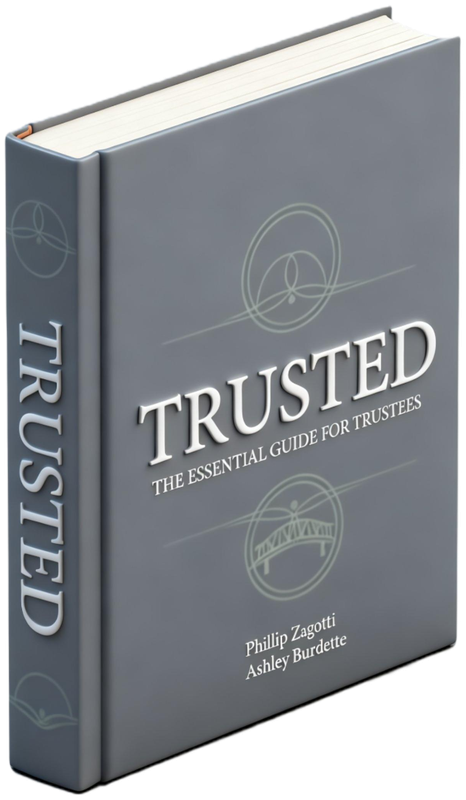
Phillip Zagotti co-authored Trusted: The Essential Guide for Trustees with Ashley Burdette, a plain-English manual on what a trustee actually has to do, from the day the trust is funded through the final accounting. The book is the basis for his eight-part continuing legal education series on trust law for LexVid, taught to attorneys nationwide, covering trust structure, fiduciary duties and risk management, and government benefits planning with special needs and Medi-Cal trusts. The same material is what goes into the trusts we draft and the administrations we handle.
Questions & Answers
Living trust questions California families ask
What does a living trust cost, and is it worth it?
A complete package is a flat fee quoted at the consultation. Measured against the probate it avoids, which for a $750,000 estate runs roughly $36,000 in statutory fees alone plus court costs and a year of delay, it pays for itself many times over for anyone who owns a home.
Do I lose control of my property when I put it in a trust?
No. You are the trustee of your own revocable trust, you keep every right you had, and you can amend or revoke it at any time. Lenders, title companies, and the assessor treat a revocable trust as you.
Will the transfer to my trust raise my property taxes or affect my mortgage?
No, if done correctly. A transfer to your own revocable trust is excluded from reassessment and does not trigger a due-on-sale clause under federal law. We file the exclusion claim with the deed.
I already have a trust from years ago. Does it need updating?
Probably. Trusts drafted before 2013 often contain A-B splits that no longer serve a purpose and cost a basis step-up; trusts drafted before 2021 do not address Proposition 19; and any trust should be reviewed after a marriage, divorce, death, move, or significant change in assets. A restatement replaces the old document without re-funding.
The plan your family will thank you for.
A free consultation with an attorney-CPA about your trust, and a flat fee in writing before you commit.