
Tax Law ✦ Penalty Abatement
The Penalties Are Often the Part That Goes Away.
A quarter or more of a typical tax balance is penalties, and penalties are the part the IRS and the Franchise Tax Board are most willing to remove: first-time abatement, California’s one-time abatement, and reasonable cause. North Star Law Firm requests them the way the agencies’ own manuals say they should be requested, with the documentation that makes them hard to deny.
The Short Answer
Yes, penalties can be removed, and interest on them goes with them.
The IRS removes failure-to-file and failure-to-pay penalties administratively for anyone with a clean three-year compliance history, no questions asked, under its first-time abatement policy. California caught up in 2022: individuals can now get a one-time abatement of the same penalties under R&TC § 19132.5. Beyond those, every major penalty can be removed for reasonable cause, meaning you exercised ordinary business care and still could not comply, because of illness, death in the family, disaster, reliance on a professional, or records outside your control. When a penalty is abated, the interest that accrued on it is abated too. On a $60,000 balance, that is frequently $15,000 to $20,000 that never has to be paid.
- IRS first-time abatement (IRM 20.1.1.3.3.2.1) for failure-to-file, failure-to-pay, and failure-to-deposit penalties
- California one-time penalty abatement for individuals, tax years 2022 and later (R&TC § 19132.5)
- Reasonable cause under I.R.C. § 6651 and R&TC §§ 19131 and 19132
- Accuracy-related penalties (I.R.C. § 6662; R&TC § 19164) removed for reasonable cause and good faith
- Estimated tax penalties, demand penalties (R&TC § 19133), and information-return penalties
- CDTFA relief for reasonable cause (R&TC § 6592) and EDD good-cause waivers (Unemp. Ins. Code §§ 1112, 1113)
The Penalties
Which penalty are you looking at, and what removes it?
Federal and California penalties look similar and are computed differently. The California failure-to-pay penalty, for example, starts at 5 percent plus 0.5 percent per month and reaches 25 percent, and the demand penalty is a flat 25 percent that stacks on top.
| Penalty | IRS | FTB | What removes it |
|---|---|---|---|
| Failure to file | 5% per month, up to 25% (I.R.C. § 6651(a)(1)) | 5% per month, up to 25% (R&TC § 19131) | First-time / one-time abatement; reasonable cause |
| Failure to pay | 0.5% per month, up to 25% (§ 6651(a)(2)) | 5% plus 0.5% per month, up to 25% (R&TC § 19132) | First-time / one-time abatement; reasonable cause |
| Demand penalty | None | 25% of the tax if you fail to file after a Demand for Tax Return (R&TC § 19133) | Reasonable cause; showing the demand was not received |
| Accuracy-related | 20% of the underpayment (§ 6662) | 20% (R&TC § 19164); 40% for certain transactions | Reasonable cause and good faith; adequate disclosure; reliance on advice |
| Estimated tax | Interest-based (§ 6654) | Interest-based (R&TC § 19136) | Waiver for casualty, disaster, or retirement/disability; annualized-income computation |
| Failure to deposit (payroll) | 2% to 15% (§ 6656) | EDD: 15% (Unemp. Ins. Code § 1112) | First-time abatement (IRS); good cause (EDD) |
| Trust fund recovery | 100% of the unpaid trust fund tax (§ 6672) | Personal assessment (R&TC § 6829; UIC § 1735) | Not a penalty in the ordinary sense; defended on responsibility and willfulness |
How does California’s one-time abatement work?
For taxable years beginning on or after January 1, 2022, an individual can have the failure-to-file and failure-to-pay penalties abated once, on request, if three things are true: no prior request for this relief, timely filing of all required returns and no timeliness penalties for the four preceding years (or any that were imposed were abated), and full payment of the underlying tax, or an approved installment agreement (R&TC § 19132.5). It is requested on FTB Form 2918 or by phone, and the FTB grants it without a reasonable-cause showing. It does not cover the demand penalty, the accuracy penalty, or business entities, which still require reasonable cause on FTB Form 2924.
What counts as reasonable cause?
The standard is ordinary business care and prudence. Serious illness of the taxpayer or an immediate family member, death, natural disaster, unavoidable absence, records destroyed or unobtainable, and erroneous advice from a tax professional on which you reasonably relied are the classic grounds, and each has a documentation pattern the agencies expect: medical records, death certificates, insurance claims, correspondence with the preparer. Ignorance of the law, a preparer’s failure to file on time, and financial inability alone generally do not qualify, although financial inability combined with hardship facts sometimes does for the failure-to-pay penalty.
The IRS considers a written request with exhibits; if it is denied, the denial is appealable. The FTB considers the same on Form 2917 (individuals) or 2924 (businesses), and its denial can be pursued through a claim for refund and, ultimately, the Office of Tax Appeals. Penalty relief is a written argument supported by documents, and it succeeds far more often when the argument tracks the agency’s own penalty handbook.
The Attorney-CPA Difference
Every penalty on the transcript has a removal path. We know which one.
- First-time and one-time abatement claimed wherever the compliance history allows
- Reasonable cause requests written to the agencies’ own standards, with exhibits
- Accuracy-related penalties defended on disclosure and reliance
- Denials appealed rather than accepted
Proof, In Print
He wrote the book on tax defense. Literally.
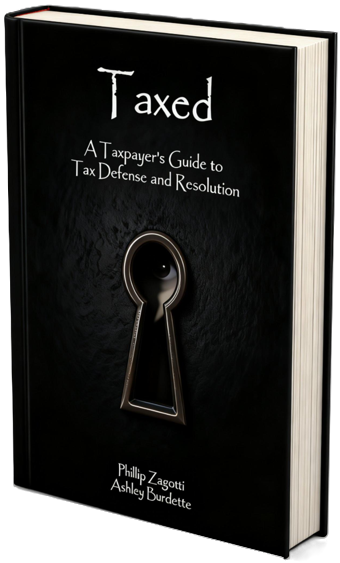
Phillip Zagotti co-authored Taxed: A Taxpayer’s Guide to Tax Defense and Resolution with Ashley Burdette. Its penalty chapter lists every common penalty, what removes it, and how to ask, so you can request first-time abatement yourself if that is all you need. When the request needs a lawyer’s letter, the consultation is free.
Questions & Answers
Penalty abatement questions we hear most
Can I ask for first-time abatement myself?
Yes, with a phone call to the IRS or a written request, and you should if your only issue is one late year with a clean history. The FTB one-time abatement is likewise a form. Where the balance is large, the history is not clean, or reasonable cause has to be argued, representation pays for itself.
Does abatement remove interest?
Interest on the tax itself is rarely abated (only for IRS errors or delays under I.R.C. § 6404(e)). Interest that accrued on an abated penalty is removed with the penalty, which is often the larger part of what disappears.
The FTB hit me with a 25 percent demand penalty. Is that real?
Yes. If the FTB sends a Demand for Tax Return and you do not file or respond by the deadline, the demand penalty of 25 percent of the tax is added on top of the late-filing penalty (R&TC § 19133). It can be abated for reasonable cause, and the strongest ground is usually that the demand never reached you.
I relied on my CPA and the return was still wrong. Is that reasonable cause?
For accuracy-related penalties, reliance on a competent professional to whom you gave complete information is a recognized defense under Treas. Reg. § 1.6664-4. For late-filing penalties it is much weaker, since the duty to file on time is yours. The facts and the documentation decide.
Penalties are the part of the bill that is meant to be negotiated.
A free penalty review with an attorney-CPA, and a flat fee in writing before you commit.