
Trusts & Estates ✦ California
Keep Your Family Out of Probate. Keep the Tax Bill Out of Their Inheritance.
Revocable living trusts, wills, powers of attorney, trust administration after a death, and the trust and estate tax returns that go with them. Drafted and administered by an attorney-CPA who wrote the book on being a trustee and teaches trust law to other lawyers. Flat fees. Free consultation. Serving families throughout California.
Overview
What does our trusts and estates practice cover?
Estate planning in California is, first, a probate-avoidance problem and, second, a tax problem. We solve both. The planning side is the living trust, the will, and the powers of attorney that keep a family out of court. The administration side is what happens after a death: the trustee’s duties, the notices, the accounting, the tax returns, and the distributions. Because the same attorney is a CPA, the estate and fiduciary income tax work stays in-house instead of being handed off.
- Revocable living trusts, including funding the trust and the deed work
- Trust amendments and restatements when life or the law changes
- Wills and pour-over wills; guardianship nominations for minor children
- Durable powers of attorney and advance health care directives
- Trust administration after a death: notices, inventory, accounting, distribution
- Trustee guidance and fiduciary duty counsel for family trustees
- Special needs trusts and ABLE accounts that protect public benefits
- Medi-Cal planning and asset protection trusts
- Trust and estate income tax returns (Forms 1041 and 541) and the estate tax return (Form 706)
- Basis step-up, community property, and Proposition 19 planning for real estate
The Cost of Doing Nothing
What does California probate actually cost?
California sets the fees for the attorney and the executor by statute (Prob. Code §§ 10800 and 10810), as a percentage of the gross value of the estate, before debts and mortgages are subtracted. Each of them gets the full fee. A house with a mortgage is valued at its full market value. The numbers below are per person; double them for the combined cost.
| Gross estate value | Statutory fee (each, attorney and executor) | Combined ordinary fees |
|---|---|---|
| $500,000 | $13,000 | $26,000 |
| $750,000 | $18,000 | $36,000 |
| $1,000,000 | $23,000 | $46,000 |
| $1,500,000 | $28,000 | $56,000 |
| $2,000,000 | $33,000 | $66,000 |
Why the Trust
Why is a living trust the standard plan for California homeowners?
Because California probate is slow, public, and expensive. A typical uncontested probate in Riverside or San Bernardino County runs nine to eighteen months, everything filed becomes a public record, and the fees in the table above come off the top. A properly funded revocable living trust avoids all of it. The trust owns the house and the accounts while you are alive; you control everything as trustee; and when you die, your successor trustee distributes the assets without a court, usually in a few months, for a fraction of the cost.
The word that matters in that paragraph is funded. A trust that does not hold title to the house is a stack of paper. We prepare and record the deed that moves the property into the trust, handle the assessor’s change-in-ownership exclusion so the transfer does not trigger a property tax reassessment, and give you a written funding checklist for the accounts. That step is the one the document services skip, and it is the one that decides whether the plan works.

The trust is the plan. Funding it is what makes it work.
What goes into a California living trust package?
A complete plan is a revocable living trust, a pour-over will that catches anything left outside the trust, a durable power of attorney for finances, an advance health care directive, HIPAA authorizations, and the deed and assignment documents that fund the trust. For married couples we address community property treatment, which gives both halves of community property a full basis step-up at the first death under I.R.C. § 1014(b)(6), and whether an A-B trust structure still makes sense given today’s federal estate tax exemption.
The trust itself is drafted for your family, not from a form. Blended families, a child who should not receive money outright, a beneficiary with a disability or a creditor problem, a family business, and out-of-state property each change the drafting. Every plan is reviewed with you before it is signed, and we keep the plan current with amendments or a restatement when the law or your circumstances change. Read more →
Do I still need a will if I have a trust?
Yes. The pour-over will is the safety net: anything titled in your individual name at death, whether by oversight or because it was acquired after the trust was signed, passes under the will into the trust. For parents of minor children, the will is also where guardians are nominated. Without a nomination, the probate court chooses.
A will-only plan can still be right for some people: a renter with modest accounts, or someone whose assets pass by beneficiary designation. California’s small estate procedures under Prob. Code § 13100 allow personal property below the statutory threshold (adjusted every three years) to pass by affidavit, and since 2025 a primary residence up to $750,000 can pass by a simplified petition. We tell you which plan fits rather than selling a trust to everyone. Read more →
I’m the successor trustee. What do I actually have to do?
More than most people expect, and on a schedule. Within 60 days of the death, California requires the trustee to send a formal notice to every beneficiary and heir under Prob. Code § 16061.7; that notice starts the 120-day clock for a trust contest. The trustee then inventories and values the assets, obtains a tax ID for the now-irrevocable trust, files the decedent’s final income tax returns and the trust’s fiduciary returns, pays debts and expenses, keeps records sufficient to account to the beneficiaries under Prob. Code § 16062, and distributes according to the trust terms.
Every step carries a fiduciary duty, and a trustee who guesses can be personally liable to the beneficiaries. We guide family trustees through the process step by step or handle the administration for them, including the real property transfers, the Proposition 19 filings with the assessor, and all of the tax filings. This is the work Trusted was written about, and the work Phillip teaches in his continuing legal education series for other attorneys. Read more →
How do I provide for a family member with a disability without costing them their benefits?
With a special needs trust. Supplemental Security Income and Medi-Cal are needs-based; an inheritance received outright can disqualify the beneficiary until it is spent down. A third-party special needs trust, funded by parents or grandparents, holds the inheritance for the beneficiary’s supplemental needs without counting as their resource, and it is not subject to Medi-Cal recovery at their death. A first-party trust, funded with the beneficiary’s own assets, works differently and does carry a payback requirement.
ABLE accounts under I.R.C. § 529A complement the trust for smaller amounts and day-to-day expenses. We draft the trust, coordinate it with the rest of the family’s plan, and counsel the trustee on distributions that do not jeopardize eligibility. For older clients, we also address Medi-Cal long-term care planning, including the timing rules and the estate recovery rules that changed in 2017 for assets held in a living trust. Read more →
What tax returns does a trust or estate have to file?
After a death, there is the decedent’s final Form 1040 and California Form 540; the trust’s or estate’s fiduciary income tax returns, federal Form 1041 and California Form 541, for each year until the assets are distributed; and, for larger estates, the federal estate tax return, Form 706, due nine months after death. California has no estate or inheritance tax, but it does tax trust income, and its rules for when a trust is a California resident trust are their own trap.
Fiduciary income tax has rules of its own: distributable net income, the 65-day election, the choice between distributing income and retaining it at compressed trust brackets, and the basis step-up on inherited assets that has to be documented before anything is sold. As a CPA-led firm we prepare these returns in-house as part of the administration rather than sending the trustee to find a preparer who has never seen a Form 1041. Read more →

The Attorney-CPA Difference
Estate planning is a legal document with a tax return inside it. We handle both.
- Trusts drafted with the income tax and basis consequences designed in, not discovered later
- Funding handled to completion: deeds recorded, assessor exclusions filed, accounts retitled
- Trust administration and the fiduciary tax returns done by one office
- Trustee guidance from the co-author of Trusted: The Essential Guide for Trustees
- Flat fees for planning packages and most administrations, quoted in writing
Proof, In Print
He wrote the book for trustees. And teaches it to other lawyers.
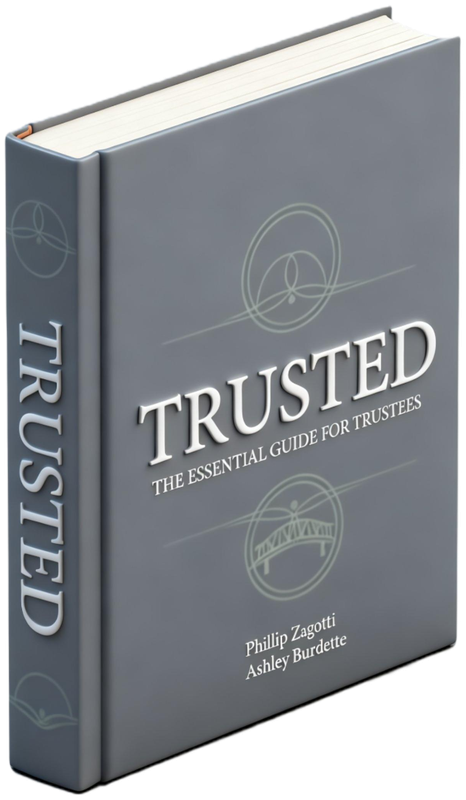
Phillip Zagotti co-authored Trusted: The Essential Guide for Trustees with Ashley Burdette, a plain-English manual on what a trustee actually has to do, from the day the trust is funded through the final accounting. The book is the basis for his eight-part continuing legal education series on trust law for LexVid, taught to attorneys nationwide, covering trust structure, fiduciary duties and risk management, and government benefits planning with special needs and Medi-Cal trusts. The same material is what goes into the trusts we draft and the administrations we handle.
Questions & Answers
Trust and estate questions California families ask us
How much does a living trust cost?
A complete plan (trust, pour-over will, powers of attorney, health care directive, and the deed to fund the trust) is a flat fee quoted before you engage, with a modest addition for a married couple’s joint plan or for additional properties. Recording fees are paid to the county.
Will putting my house in a trust raise my property taxes?
No, if it is done correctly. A transfer into your own revocable trust is excluded from reassessment, and we file the assessor’s change-in-ownership form claiming the exclusion at recording. The Proposition 19 rules that limit the parent-child exclusion apply when the house passes to your children, and we plan for that too.
My parent died with a trust. Do I have to hire the lawyer who wrote it?
No. The successor trustee chooses counsel. Many family trustees come to us precisely because they want an attorney-CPA who can handle the administration and the tax returns together.
Can you help if I have property in another state?
Yes. A California living trust can hold property in other states, and doing so avoids a second probate there. Out-of-state property needs a deed prepared under that state’s law, which we coordinate.
The plan your family will thank you for.
A free consultation with an attorney-CPA about your trust, will, or a trust you have been asked to administer. Flat fee in writing before you commit.